


In this educational series, we will guide you step-by-step through the rules of backgammon, from setting up the board to the advanced strategies used by experienced players.

Backgammon is one of the oldest and most fascinating board games in the world! If you are new to the game or wish to refresh your knowledge, this page is the perfect starting point. Backgammon is not just a game of luck with dice; it is a deep strategic battle where skill, planning, and a bit of fortune determine the winner. In this introduction, we will walk you through the essential elements of the game, the board setup, and your first steps, so you are ready to dive deeper into the rules on the following pages.
History of the Game
Backgammon is one of the oldest board games in history, with roots tracing back more than 5,000 years. Archaeological excavations in Iran, Mesopotamia, and Egypt have revealed boards and pieces with dimensions nearly identical to those we use today. At Shahr-e Sukhteh, an archaeological site in Iran, a 5,000-year-old backgammon board was discovered alongside pieces that served as dice.
The Romans played their own variant named Ludus Duodecim Scriptorum (The Game of Twelve Lines), which evolved into tavla, and later into modern backgammon. Throughout the millennia, the game journeyed through Persian sultanates, the Ottoman Empire, European courts, and finally into a modern global competition. This extraordinary longevity is no accident—the game endures because it offers an unparalleled blend of luck, strategy, psychology, and mathematics that never grows old.
What fascinates researchers and game philosophers is precisely this equilibrium: backgammon is unpredictable enough to remain exciting, yet deep enough to reward knowledge and skill over time. No other game has managed to balance these two seemingly opposing elements so precisely.
The Difference Between Backgammon and Tavla
Although the terms backgammon and tavla are often used interchangeably, there is one important distinction between them:
- In modern backgammon, a doubling cube is used, allowing players to increase the stakes of the match during a game.
- In traditional tavla, the doubling cube is not used, and the game is played without the option to double.
All other fundamental rules—checker setup, movement, hitting, and bearing off—are completely identical.
The Core Objective of the Game
The game is played between two players, each with 15 checkers. The objective is simple yet challenging: be the first to remove all your checkers from the board (a process known as “bearing off”). Checkers move across the board based on the roll of two dice, but your opponent can block your path, “hit” your checkers, and send them to the bar.
Board Setup: What Does It Look Like?
The board consists of 24 triangles (known as “points”), divided into four quadrants of 6 points each:
- Home board: The area from which you bear off your checkers (points 1–6 for you).
- Outer board: Points 7–12.
- Opponent’s home board: Points 19–24 (from your perspective).
- Opponent’s outer board: Points 13–18.
In the middle of the board is the bar (the ridge) where “hit” checkers are placed. Next to the board is the doubling cube (a die used to double the stakes of the game, marked with the numbers 2, 4, 8, 16, 32, and 64).
Initial Setup (Standard for Both Players):
- 2 checkers on point 24 (your furthest point).
- 5 checkers on point 13.
- 3 checkers on point 8.
- 5 checkers on point 6 (your closest point in your home board).

The checkers move in opposite directions: in this scenario, White moves clockwise, and Black moves counterclockwise.
How the First Move is Determined
At the start of the game, both players roll a single die.
- The player who rolls the higher number plays first and uses both numbers rolled (theirs and the opponent’s) for their first move (e.g., if you rolled a 5 and your opponent rolled a 3 → you play 5-3).
- If the numbers are equal (e.g., both roll a 4), the players reroll until they obtain different results.
Basic Elements of the Game: Dice, Checkers, and First Steps
Dice: You roll two dice. Each number represents a separate move—you can move one checker by the first number and another checker by the second number, or move the same checker twice (the total sum of both numbers) provided that the intermediate points are open. If you roll doubles (e.g., 4-4), you play that number four times.
Movement: Checkers move only forward. You can land on an open point or on a point where you already have your own checkers. If a point is occupied by only a single opponent’s checker (a “blot”), you “hit” it and send it to the bar.
Blocks: If the opponent has two or more checkers on a point, that point is closed—you cannot land there. This directly impacts how you use your rolled numbers:
- If both rolled numbers lead to blocked points for a specific checker, you cannot move that checker—but if your other checkers have legal moves, you must play them.
- If you can only play one of the two numbers—where one is playable and the other is not—you must play the higher number if it is at all possible.
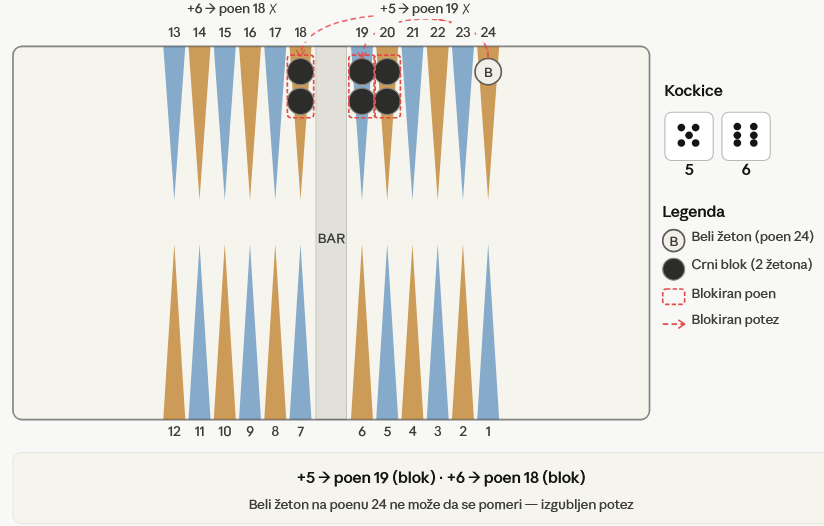
From the bar: If your checker is hit, it must first return to the opponent’s home board before you can move any other checker.
Returning a Checker from the Bar
When an opponent “hits” your checker (lands on a point with only one of your checkers), that checker goes to the bar—the ridge in the middle of the board.
As long as you have a checker on the bar, you must first return it to play before you can move any other checker.
Entering the board is done by rolling the dice. The checker from the bar enters the opponent’s home board (points 19–24 from your perspective), landing on the point that corresponds to one of the numbers rolled. For example, if you roll 3-5, you can enter on point 21 or point 23—but only if that point is not closed (i.e., the opponent does not have two or more checkers on it).
What if both numbers block your entry?
If both points you could potentially enter are closed by the opponent’s checkers, you forfeit your entire turn. The checker remains on the bar, and you wait for your next turn.
What if only one number blocks your entry?
If one point is open and the other is closed, you must enter on the open point—even if it is disadvantageous for you. There is no choice.
Multiple checkers on the bar?
If you have multiple checkers on the bar, you can return a maximum of two in a single turn (one for each rolled number)—or up to four if you roll doubles, as each number is counted four times. Only when you have returned all your checkers from the bar can you proceed with regular movement.
Bearing Off Checkers from the Board
Once you have moved all 15 of your checkers into your home board (points 1–6), you can begin bearing off, which means removing checkers from the board. The goal is to bear off all 15 checkers before your opponent does.
The Fundamental Rule: You roll the dice and bear off a checker from the point that corresponds to the number rolled. For example, if you roll a 3, you bear off a checker from point 3.
What if there is no checker on that point? There are two scenarios:
- If the point is empty but you have checkers on higher points—you must move a checker from any higher point by that number (as a normal move within the home board).
- If the point is empty and there are no checkers on higher points—you bear off a checker from the highest occupied point. For example, if you have checkers only on points 2 and 4 and you roll a 6—you bear off a checker from point 4.
A checker hit during bearing off: If the opponent hits your checker while you are bearing off, that checker goes to the bar. It must re-enter the game and travel all the way back to your home board before you can resume bearing off. This can be a critical moment in the match—a single hit checker can completely turn the tide of the game.
Let’s look at two different situations:


Winning the Game
The first player to bear off all their checkers from the board is the winner. However, not all victories are equal—the score depends on how far the opponent has progressed in the game:
- Single Win (1 point) — The opponent has managed to bear off at least one checker from the board.
- Gammon (2 points) — The opponent has not borne off a single checker, but all of their checkers are in play (none are on the bar or left in your home board).
- Backgammon (3 points) — The opponent has not borne off a single checker, and additionally has one or more checkers still on the bar or within your home board.
Why is this important?
In a match play (which is played to a predetermined number of points), the difference between a single win, a gammon, and a backgammon can be decisive. A gammon can suddenly bring you…
The Doubling Cube and the Score
If the doubling cube was used during the game, the final score is multiplied by the current value of the cube. For example, a gammon (2 points) with the cube at 4 awards 8 points. Because of this, the decision to accept or refuse a double can be just as crucial as the moves on the board themselves.
If any of this was unclear, watch the video – Grandmaster Marc Olsen explains the rules of backgammon.
Following this lesson, upcoming topics will cover basic strategies, openings, the endgame, and the use of the doubling cube, while the final lesson will explain how to proceed further.


